

The letters are there. What did the relationship add?
Place three letters in front of you: A, C and T. We can read CAT, then rearrange them to read ACT. The letters remain, while what we read from them changes. Between the individual letters and the word, we encounter order, the conventions of language and the surrounding information that gives a reading its meaning.
This small example opens a broader question: when we look at a system, can we understand it simply by listing its parts? Or do we also need to know what distinguishes those parts, how they connect and what allows them to change while continuing to function?
The Unified Framework of Systemic Boundaries explores this question through examples from language, digital and biological systems, and organisations. It brings them together through a language for comparison and inquiry, while considering the characteristics and mechanisms of each domain.
What do we mean by boundaries?
A boundary might be a physical membrane, a scope of authority or a definition that distinguishes what we are discussing. The exploration therefore begins by identifying the system in question: what do we count as part of it? What environment does it interact with? What kind of exchange are we trying to understand?
In a cell, the plasma membrane separates the interior from the surrounding environment and regulates the passage of substances into and out of the cell. Alongside separation, it has a role in exchange and regulation. The US National Human Genome Research Institute describes the membrane as semipermeable and explains that it regulates transport across it.
In Linux, system calls provide entry points into the kernel for requesting its services. These requests are usually made through wrapper functions in a language library. The example lets us examine passage between two levels and the interface that organises it: how does interaction work across a boundary?
Three elements to consider together
The framework proposes considering boundary integrity, the effectiveness of internal connections and adaptive flexibility together. Depending on the case, boundary integrity concerns clear distinctions, points of passage and permissions. Effective connections concern the relationships that allow parts to perform a shared function. Flexibility concerns the room for adaptation that permits an appropriate response to change while maintaining the system’s core identity.
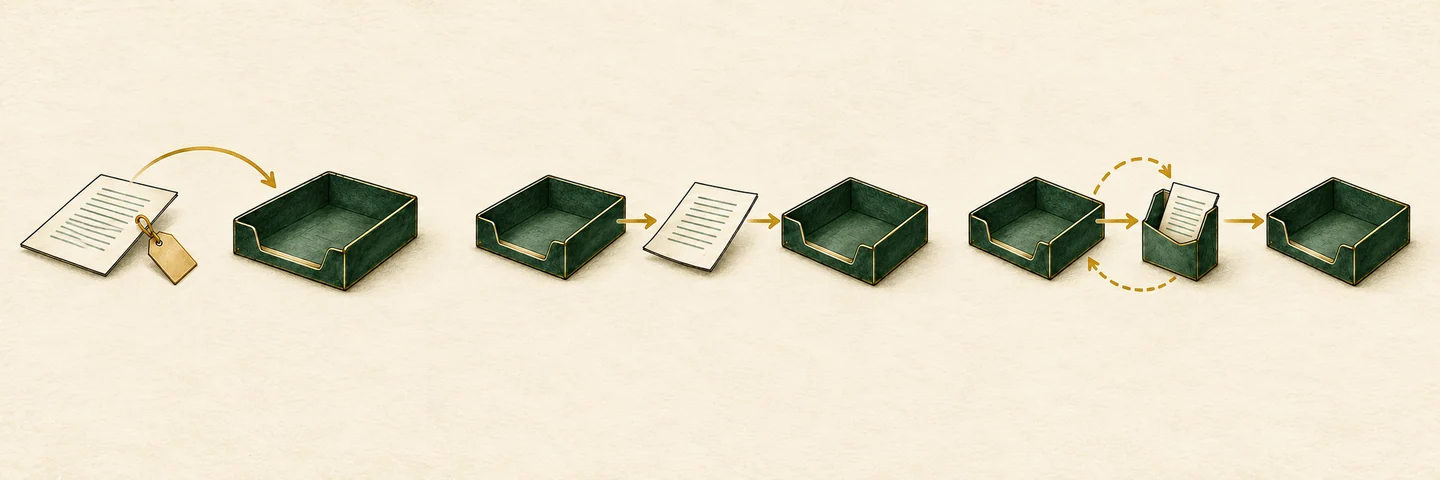
In a hypothetical organisational example, each department might understand its own responsibilities, yet a service still stalls because the information needed to move from one department to another has not been defined. The connection itself deserves examination. Alternatively, the handover steps may be clear, but a new request remains pending because the procedures provide no way to review or escalate it. That raises a question about flexibility.
These elements need to be considered in relation to how the system works. The number of restrictions alone does not tell us how well a system works, and the volume of messages is not enough to judge the quality of its connections. We need to identify what each arrangement does, what it makes possible and how we can observe its effects.
From distinction to identity and meaning
Within the framework, I propose examining the relationship between boundaries, identity, meaning, organisation and stability. Defining what we are dealing with helps us distinguish its identity. Relationships and surrounding conditions help us understand its meaning and function. We can then investigate how these elements work together and how that work continues under changing conditions.
In language, we draw on our knowledge of the language and the situation in which it is used to understand a word. In cells and software, we examine the mechanisms specific to each.
How can we use this perspective?
Take the phrase ‘delivered’. Before organising follow-up around it, we need to know what it means in this case: has the output been sent, checked or accepted by the other party? We then identify who owns each step, what information travels with it and what route is available when an exception occurs. Questions about boundaries, meaning and connections become things we can observe at work.
An initial exploration can begin with four questions: what system are we studying? What distinguishes its parts and organises passage between them? What relationships are necessary for its function? How does it handle exceptions and change? We then need data to show whether this diagnosis is useful and what alternative explanations might account for the problem.
From an idea to observation
A useful test starts with a specific case, clearly defined indicators, observations that others can review and a comparison with an alternative explanation. What do we expect to improve? How would we know whether a change resulted from the proposed action or from another factor? These questions can turn an interesting comparison into work worth examining.
The next article begins with something familiar: red. How do we use one colour name, yet understand different messages when its setting changes?

